Synthetic Underlayment vs Felt Paper: Which Is Better for Your Roof?

Aaron Venegaz is the President and founder of Global Exterior Experts and has been in the construction / roofing industry for over 15+ years. He started the company back in 2010 and done everything from scheduling appointments to putting down roofs. He's also done everything from commercial roofing to residential roofing and has also worked with almost every single roofing material multiple times over the past 15 years.
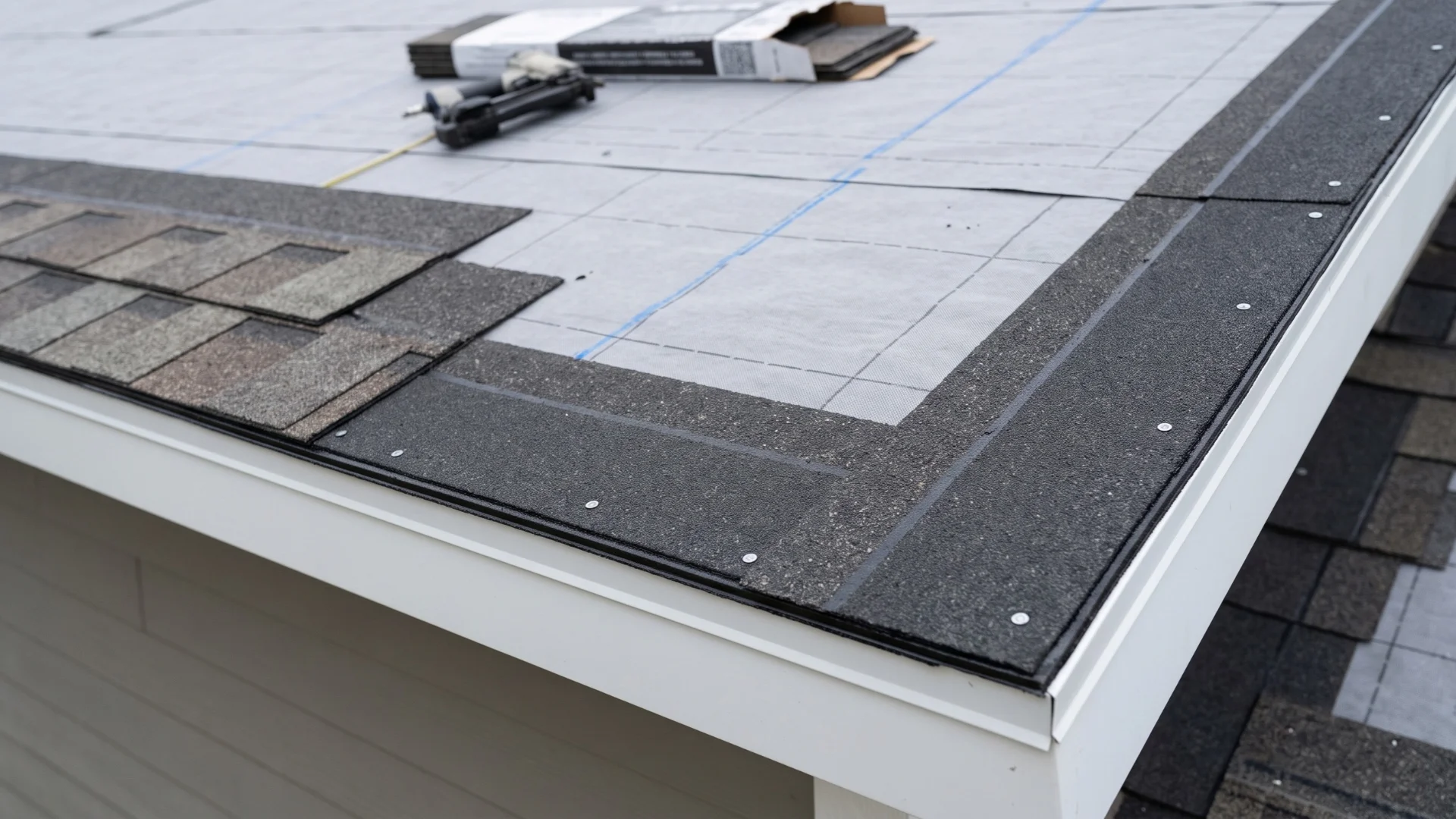
Starter shingles are the first row of material a roofing company installs along the bottom edge (the eaves) and side edges (the rakes) of your roof, right before the shingles you actually see. They are plain strips, usually dark, with a line of adhesive along the outer edge. They matter because they seal down the first course of shingles against wind, cover the joints between those shingles so water can't reach the deck, and give the whole roof a straight, clean edge.
What Is a Starter Shingle?
A starter shingle (also called a starter strip) is a narrow asphalt strip with no tabs or cutouts. It goes under the first course of shingles, adhesive side toward the edge. Nobody ever sees it once the roof is done, which is exactly why it gets skipped (more on that below).
The Three Jobs a Starter Strip Does
Here's the thing: a starter strip does more work than almost any other piece on the roof.
- Seals the edge. The adhesive line bonds the first course down. Without it, the lowest shingles are held by nails alone, and wind gets under them first.
- Covers the joints. Every shingle in the first row has a seam next to it. The starter sits under those seams so water lands on asphalt instead of bare underlayment.
- Sets the line. A straight starter gives the crew a true edge to work from, so every row above it stays square.
Those three jobs are why the starter course is part of the roof system, not an add-on.
Where Starter Shingles Go
Alright, let's talk placement. Starter strips run along two edges:
- The eaves (bottom edge). Required on every asphalt shingle roof, no exceptions.
- The rakes (gable edges). Not every roof gets these, but it should. The rake starter seals the ends of each course and carries a big share of the roof's wind resistance.
The strip overhangs the drip edge by about a quarter inch to three quarters of an inch. The adhesive faces out toward the edge, not up the slope. Nails go 3 to 4 inches in from that edge so they never sit in the exposed zone.
Get the orientation backwards and the adhesive lands too high to seal anything. (Yes, that happens more often than you'd think.)
What Goes Wrong Without One
Of course, none of this feels urgent until a storm shows up.
Skip the starter, or install it backwards, and the first course has nothing holding it down but nails. That row lifts first in high wind, and once it lifts, the row above it is exposed. A three-year-old roof can lose its bottom two courses on one side of the house for this one reason.
The water problem is quieter. Rain slips through the seams in the first row, hits the underlayment, and works its way to the fascia and the top of the wall. By the time a stain shows up inside, the deck edge may already be soft.
Signs to watch for:
- Shingles flapping along the bottom edge after a windy day
- A wavy or ragged roofline at the gables
- Staining on the fascia board or soffit
Factory Starter Strips vs. Cut-Up Three-Tabs
There are two ways to build a starter course.
Option one is a factory starter strip. It comes in a bundle, often perforated so one piece splits into two strips, with the adhesive already in the right spot. One bundle covers roughly 100 to 120 linear feet of edge.
Option two is cutting the tabs off standard three-tab shingles. Done carefully, it works. Done fast, the adhesive lands in the wrong place or the cuts drift, and it eats labor on the roof.
The standard here is the factory strip. It's uniform, quicker to install, and matches the manufacturer's written specs, which matters for warranty (next section). The old trick of flipping a three-tab upside down is not a starter. It's a gamble, because the adhesive ends up a full tab height above the edge where it seals nothing.
Code, Inspections, and Warranty
Here's something property owners rarely hear: the building code itself says very little about starters. What it does say is that asphalt shingles must be installed per the manufacturer's instructions. Every major manufacturer's instructions require a starter course at the eaves, and most now call for it at the rakes too.
That makes the starter a code item by reference. Inspectors in stricter counties will ask about it, and some want to see the edge before the first course goes on. Plan for that when scheduling the inspection, or the crew ends up waiting on the roof with the field shingles stacked.
Missing or mismatched starters can also void an enhanced warranty. Manufacturers tie their best coverage (some run 50 years, non-prorated) to using their full system, starter included. Who would've thought a strip nobody sees could decide a 50-year warranty?
What Starter Shingles Cost
Starter strips are one of the cheapest line items on a roof replacement.
- Material: roughly $30 to $60 per bundle, with one bundle covering about 100 to 120 linear feet
- A typical house with 150 to 250 feet of eaves and rakes needs two or three bundles, so $60 to $180 in material
- Labor: a little extra time at the edges, usually under an hour for a crew
Compare that to a full roof replacement, which runs $10,000 to $25,000 or more for most single-family homes depending on size, pitch, and shingle grade. The starter course is well under 1% of the job.
Adding a starter after the fact is a different story. It means pulling the first two courses off every edge, so a $150 item turns into a $1,500 to $3,000 repair. Pay for it once, on day one.
Where It Fits in a Roof Replacement Timeline
A standard roof replacement on a one-story home takes one to two days. The starter course is maybe 30 to 60 minutes of that.
The order on install day:
- Tear-off and deck inspection
- Ice and water shield at the eaves, then underlayment
- Drip edge
- Starter strips at the eaves and rakes
- Field shingles, then ridge cap
The starter goes on before any visible shingle, so if you only watch one thing that day, watch the edge.
Delays rarely come from the starter itself. They come from rotted decking found after tear-off, a permit held up at the county office, or a color-matched starter for designer shingles that didn't ship with the main pallet. Build one buffer day into your plans and you'll rarely need it (but you'll be glad it's there when you do).
How to Check Your Own Roof
You can check for a starter course from a ladder at the eave, or from the ground with binoculars (safer, and nearly as good).
- Lift the bottom edge of a first-course shingle gently. You should feel asphalt under the seam, not bare underlayment or metal drip edge.
- Look down the gable edge. A straight, even line usually means a rake starter is there. A ragged line usually means it isn't.
- Check the seal. In warm weather the first course should be stuck down, not loose.
If you find loose shingles or exposed underlayment, don't pull on anything. Call a roofing company for an edge inspection before the next wind event.
Questions to Ask Before You Sign
Before you sign a roof replacement contract, get clear answers to these:
- Is a starter course included at both the eaves and the rakes?
- Is it a factory starter strip or cut three-tabs?
- Does the starter match the shingle manufacturer's system for the enhanced warranty?
- Will the drip edge go under the ice and water shield at the eaves and over the underlayment at the rakes? (That's the right answer, and it's a quick way to tell who knows the details.)
A good estimate lists the starter by product name. If it's not on the paper, assume it's not going on the roof.
Summary and What to Consider Next
Starter shingles are the unseen first row that seals, covers, and squares the edge of an asphalt roof. They cost very little, take under an hour, and every major shingle manufacturer requires them. Skip them and the roof's weakest point gets weaker.
What to do next:
- Planning a roof replacement? Make sure the starter course is written into the scope, at the eaves and the rakes, by product name.
- Roof already on? Do the edge check above after the next windy day.
- Anything loose or exposed? Schedule an edge inspection before it turns into a leak and a drywall repair.
The edge of the roof is where wind and water start their work. Get the starter right and most of that work never gets past the first row.