Why Are Granules From My Shingles in the Gutters?

Aaron Venegaz is the President and founder of Global Exterior Experts and has been in the construction / roofing industry for over 15+ years. He started the company back in 2010 and done everything from scheduling appointments to putting down roofs. He's also done everything from commercial roofing to residential roofing and has also worked with almost every single roofing material multiple times over the past 15 years.
A roof sags in the middle when the framing underneath can no longer carry the weight sitting on it. The usual causes are undersized or cracked rafters, a weak ridge, walls spreading apart, water-rotted decking, too many layers of shingles, or heavy snow and ice. A sag is a structural problem, not a cosmetic one, and it will not straighten out on its own.
The good news: most sagging roofs can be fixed before they turn into an emergency. As a roofing company, we treat every sag the same way. First we find what is failing. Then we decide whether it calls for a repair, added support, or a full roof replacement. This guide walks you through both steps.
Sagging vs. Wavy: Know What You Are Looking At
Before anything else, figure out which problem you have. They look similar from the driveway, but they are not the same thing.
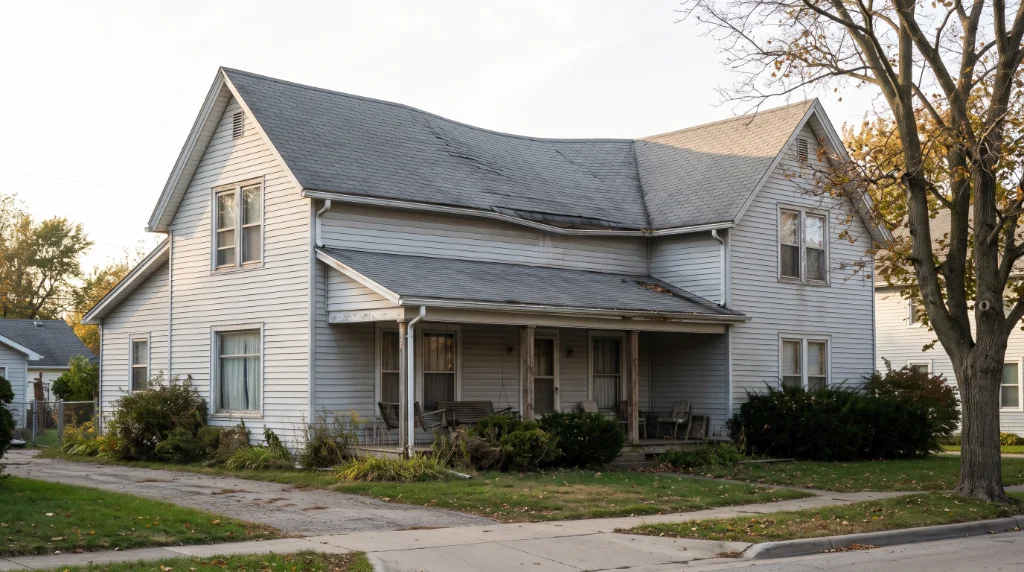
A sagging roof has a real dip. The ridge line (the peak running along the top) bows down in the middle like a tired clothesline, or one whole slope looks scooped out. That points to the framing.
A wavy roof has ripples or lines across the surface, but the overall roof plane is still straight. That usually points to the decking, the wood sheets right under the shingles.
A quick way to tell:
- Stand at one end of the house and sight down the ridge. It should be straight as a string.
- Look across each slope early in the morning or near sunset. Low light makes dips and waves pop.
- A dip you could lay a bowl in is a sag. A quilted or rippled look is a wave.
Both need attention. A sag in the middle just needs it sooner.
7 Reasons a Roof Sags in the Middle
Here's the thing: shingles never cause a sag. They only show you what the wood underneath is doing. So the real question is which piece of that wood has given up.
1. Rafters That Are Too Small or Spaced Too Far Apart
Rafters are the sloped boards that hold up the roof. On many older homes and add-ons, they were cut from smaller lumber or set farther apart than today's codes allow. They hold for decades, then slowly bow under the load.
2. The Walls Are Spreading
This one surprises people. A roof pushes outward on the walls, and ceiling joists or rafter ties are what hold those walls together. If those ties are missing, undersized, or were cut during a remodel, the walls creep outward and the ridge drops in the middle. A sagging ridge with walls that lean out at the top is the classic sign.
3. Water Damage and Rot
A slow leak around a chimney, valley, or vent soaks the decking and the tops of the rafters. Wet wood goes soft, and soft wood sags. The leak may be years old before you ever see a stain inside.
4. Too Much Weight
Every roof is built for a set load. These push it over the limit:
- Two or three layers of shingles stacked on top of each other
- Heavy, wet snow and ice that sits for weeks
- Heavier materials (like tile or slate) installed on framing built for asphalt
- Rooftop equipment or solar added without checking the structure
5. Cut or Damaged Trusses
Trusses are engineered as a single unit. Cut one web to fit a furnace duct or an attic storage platform (it happens more than you'd think) and the whole truss loses strength. Cracked or loose metal connector plates do the same thing.
6. Trapped Attic Moisture
Poor ventilation lets warm, damp air sit against the underside of the roof. Over many seasons the decking swells, softens, and droops between the rafters. Frost or rusty nail tips in the attic in winter are the giveaway.
7. Age, Pests, and Old Shortcuts
Wood gets tired. Termites and carpenter ants speed that up, and so do past repairs done without proper bracing. Often a sag is two or three of these causes stacked together, not just one.
Is a Sagging Roof Dangerous?
Short answer: it can be. A small dip that has not moved in years is rarely about to fall in. A sag that is new or growing is a different story.
Get people out of the rooms below and call for help right away if you notice:
- A sag that showed up suddenly or got worse after a storm or heavy snow
- Cracking, popping, or creaking sounds from the attic
- New cracks where the walls meet the ceiling
- Upstairs doors or windows that suddenly stick
- A ceiling that is bowing down, or daylight showing through the roof boards
No warning signs? You likely have time to plan, but not time to ignore it. Sags only move in one direction.
What You Can Safely Check Yourself
Alright, let's talk about what you can do before anyone shows up. You can learn a lot from the ground and the attic, and it makes the inspection go faster.
- Take photos from the street. Shoot the ridge from both ends of the house. Date them so you can compare later.
- Count the shingle layers. Look at the roof edge by the gutter. Stacked, thick edges mean more than one layer.
- Look in the attic with a flashlight. Check for cracked or bowed rafters, dark water stains, soft or moldy decking, and any framing that has been cut.
- Check upstairs ceilings and walls. Note any new cracks or stains.
- Write down the timeline. When did you first see it? Has it changed?
One firm rule: stay off the roof. If the decking is soft, it may not hold you. In the attic, step only on the framing, never on the drywall between the joists.
How a Sagging Roof Gets Fixed
The fix depends on what failed. New shingles alone never fix a sag, because shingles follow whatever shape is under them. Here is what the real repairs look like, from lightest to heaviest.
- Replace Bad Decking
If the framing is sound and only the decking is soft, the damaged sheets get cut out and replaced. This is almost always done during a roof replacement, since the shingles have to come off to reach it.
- Sister the Rafters
Sistering means bolting a new, full-length board alongside a cracked or bowed rafter. The roof is often jacked up slowly first (over days, not minutes) so the old wood does not split.
- Add Bracing and Ties
For spreading walls or long, unsupported rafters, we add the support that was missing: rafter ties, collar ties, purlins, or a knee wall in the attic. It is not glamorous work, but it stops the movement.
- Repair Trusses the Right Way
A damaged truss cannot just be patched with a scrap of lumber. Code calls for a repair designed by an engineer, with a stamped drawing the inspector can check.
- Rebuild the Structure and Replace the Roof
When rot or failure is spread across the roof, the practical answer is a full tear-off: remove everything, rebuild or reinforce the framing, install new decking, then put on the new roof. If your shingles are near the end of their life anyway, combining structural repair with a roof replacement usually costs less than doing them as two separate jobs.
What Does It Cost to Fix a Sagging Roof?
Of course, none of this comes free. Prices swing with your region, roof pitch, attic access, and how much damage is hiding. These are broad ranges for a typical single-family home, not quotes:
- Structural engineer visit and report: $300 to $1,000
- Decking replacement: $75 to $125 per sheet, installed
- Sistering rafters: $1,500 to $4,000 for a small section
- Added bracing or ties: $1,000 to $4,000
- Engineered truss repair: $500 to $2,500 per truss
- Major framing or ridge rebuild: $5,000 to $20,000 or more
- Full roof replacement with asphalt shingles: $9,000 to $20,000 or more, before structural work
Put together, a minor sag often lands between $1,500 and $7,000. A serious one with a new roof can run $15,000 to $35,000 or more.
One honest warning: nobody can see all the damage until the old roof comes off. Set aside an extra 10 to 20 percent for surprises, and ask for the per-sheet decking price in writing before work starts.
How Long the Work Takes (and What Slows It Down)
The hands-on work is usually the fast part. The waiting is what stretches the calendar.
- Inspection: about an hour, including the attic
- Engineer report: a few days to 2 weeks
- Permit approval: same day in some towns, 2 to 4 weeks in others
- Minor structural repair: 1 to 3 days
- Major framing work: 1 to 2 weeks
- Roof replacement on a typical home: 1 to 3 days
Now for the part nobody mentions up front. Structural work almost always needs a permit, and a permit can bring code surprises with it. Once the roof is open, an inspector may require upgrades the old roof never had, like better ventilation, ice barrier at the eaves, or thicker decking.
A few other things that add time:
- Most codes allow only two layers of shingles. A third layer means a full tear-off, no exceptions.
- Old homes often have spaced plank decking that has to be sheeted over before new shingles go on.
- Engineered beams and custom trusses are special order and can take 2 to 6 weeks to arrive.
- Rain delays everything. An open roof and a wet forecast do not mix.
Will Insurance Cover a Sagging Roof?
Sometimes. Homeowners insurance generally pays for sudden damage, such as a tree strike, a windstorm, or the weight of snow and ice. It generally does not pay for slow problems like age, long-term leaks, rot, or framing that was undersized from day one.
If the sag appeared right after a storm, call your insurer before any repairs start and send them your dated photos. It is also worth asking whether your policy includes "ordinance or law" coverage. That is the part that helps pay for code-required upgrades (who would've thought the fine print could matter that much?).
How to Plan the Project and Pick a Roofing Company
A sagging roof is part roofing job, part structural job. The roofing company you hire should be comfortable with both, or be upfront about bringing in an engineer or framing crew.
A simple plan that works:
- Get the roof inspected from the outside and from the attic. An inspection without an attic check is only half an inspection.
- If the framing is involved, get an engineer's letter. It protects you at permit time and at resale.
- Ask for a written scope that separates structural work, decking, and roofing, with a price for each.
- Confirm who pulls the permit. It should be the company doing the work, not you.
- Schedule for a dry stretch if the roof is stable enough to wait. If it is not, ask about temporary shoring in the attic to hold it safely until the repair.
When you compare bids, be careful with any roofing company that offers to "just shingle over it." A new roof on a failing frame looks good for about one season.
The Bottom Line on a Sagging Roof
A roof that sags in the middle is telling you the structure underneath is overloaded, weakened, or both. The cause is usually undersized rafters, spreading walls, rot, extra weight, or damaged trusses. Small sags can often be braced or repaired for a few thousand dollars. Widespread damage usually means structural repair plus a roof replacement.
Once it is fixed, keeping it fixed is simple:
- Fix leaks fast, even small ones
- Keep gutters clear so water moves off the roof
- Make sure the attic is vented and stays dry
- Tear off old shingles instead of adding layers
- Never cut framing or trusses for storage or ductwork
What to consider next: take your photos today, check the attic this week, and get a roofing company out to inspect both the roof and the framing. Then weigh the age of your shingles. If they have less than five or so years left, pricing the repair and a roof replacement together is worth the conversation. The sooner you know the cause, the more choices (and the smaller the bill) you will have.